
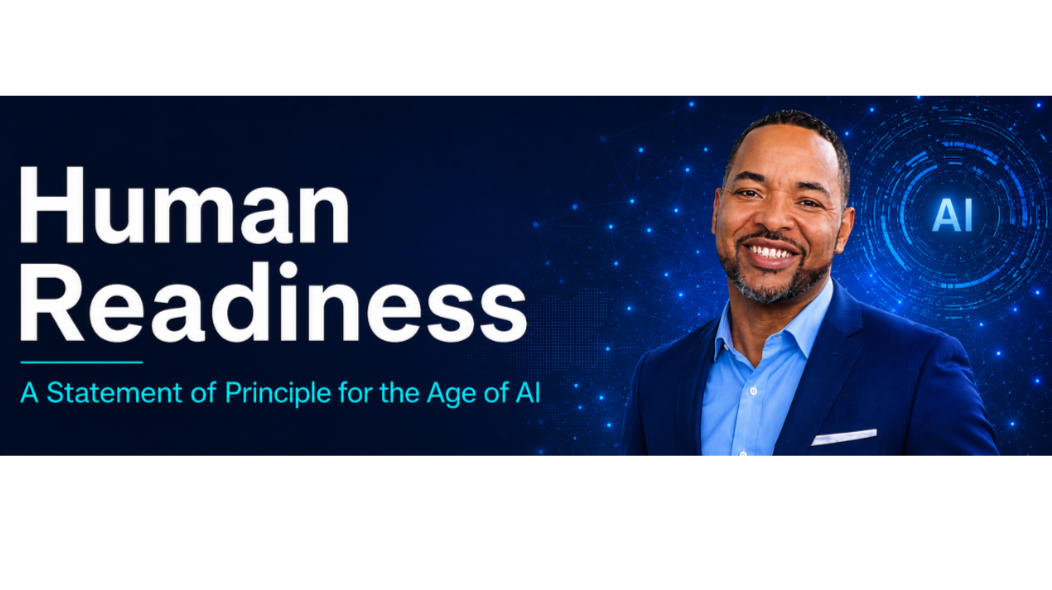
“The machines get more capable every day. The question is whether we are becoming more ready to use them wisely.”
The Question in Front of Us
Artificial intelligence is one of the most powerful tools human beings have ever created. It can expand access, increase productivity, improve decision-making, accelerate discovery, and change what individuals and organizations are capable of doing.
But access to powerful technology does not guarantee better outcomes. Those outcomes will depend on the condition of the people using it, the leaders making decisions about it, and the institutions creating the environments in which it operates.
That is where Human Readiness comes in.
Human Readiness asks us to pay as much attention to the people as we do to the technology. Are people prepared to use these tools? Do leaders understand what they are authorizing? Do organizations know where accountability belongs?
It also asks whether people are being prepared for changes in work, education, healthcare, government, and everyday life. Institutions have a role in creating the conditions for people to participate in this transition rather than simply experience its consequences.
The advancement of artificial intelligence is a technology challenge. How we choose to live with it is a human one.
What Is Human Readiness?
Human Readiness is the condition of a human being that determines how effectively they experience life, relate to others, and use the skills, tools, technology, and opportunities available to them.
In simple terms, Human Readiness is what turns access and opportunity into advantage.
A person can have access to extraordinary technology and still be unprepared to use it well. An organization can deploy the most advanced AI available and still make poor decisions. A society can increase technological capability while leaving people confused, fearful, dependent, displaced, or disconnected.
Human unreadiness becomes visible when people have access to powerful technology but lack the understanding, judgment, confidence, authority, or accountability to use it well. It appears when organizations adopt faster than they prepare, when people are expected to adapt without understanding what is changing, and when automation is introduced without considering the people who depend on the system.
It also appears when responsibility for human decisions begins to disappear behind the technology. The goal should be to advance human readiness alongside innovation so that our ability to use technology wisely grows with our ability to build it.
Where This Comes From
I spent 21 years in the United States Air Force, where readiness was not an abstract idea. It was a requirement tied directly to our ability to accomplish the mission.
During a Nuclear Surety Inspection, my unit achieved a 99% readiness score, placing us among the highest-rated units entrusted with managing nuclear weapons. I was responsible for training more than 1,200 personnel who contributed to achieving that level of readiness, and I received a Top Professional Performer Award during the inspection.
That experience shaped how I think about readiness today. We could have the equipment, technology, procedures, security systems, and resources necessary to accomplish the mission, but none of those things removed the requirement for prepared people.
People had to understand their responsibilities. Leadership had to be accountable, training had to reflect the conditions people might actually face, and communication, judgment, standards, and discipline all mattered. The system and the people had to work together.
Artificial intelligence is different technology operating in a very different environment, but the principle remains relevant. As technological capability increases, the readiness of the humans responsible for using it becomes even more important.
Principle 1: Access Does Not Equal Readiness
Giving someone access to AI does not mean they understand it, and teaching someone how to enter a prompt does not necessarily prepare them to evaluate the answer. Providing an organization with an AI platform also does not mean its leaders understand the risks, limitations, or consequences of using it.
Access matters, but readiness determines what happens after access is granted. The conversation therefore has to move beyond asking who has access to AI and begin asking whether people are ready to use it.
Principle 2: Human Accountability Must Remain Clear
AI systems are becoming increasingly capable of taking actions, making recommendations, and performing tasks with less direct human involvement. That development makes clear accountability increasingly important.
When a company eliminates a job and replaces the work with technology, human beings made the decision to deploy the technology in that way. When an organization allows an automated system to make decisions, people established the system, its parameters, its authority, and the conditions under which it operates.
Technology may perform the action, but human beings remain responsible for creating the conditions that allowed the action to occur. Technological complexity should never become a place where human responsibility disappears.
Principle 3: Good Intent Does Not Remove Harm
Technology can be created with good intentions and still cause harm. Leaders can make decisions they believe are beneficial and still create consequences they never intended.
That is why intention cannot be the only standard. We also have to examine who benefits, who carries the risk, who may be unintentionally excluded, and what happens when a system gets something wrong.
Organizations should know who has the authority to intervene and who remains accountable afterward. Responsible innovation requires enough humility to continue asking those questions after a technology has been deployed.
Principle 4: Prepare People for Change, Not Just Technology
The AI transition cannot be treated solely as a technology rollout. People need preparation for what the technology changes around them.
Workers need to understand how their roles may evolve before those changes arrive. Leaders need enough understanding to make responsible decisions about systems they may not personally know how to build, while educators need to prepare students for a world where access to information is abundant but judgment remains essential.
Communities also need opportunities to understand what artificial intelligence can do, what it cannot do, and how it may affect everyday life. Preparation reduces the distance between technological change and human capability, and that distance is where fear, confusion, dependency, poor decisions, and unnecessary displacement can grow.
Principle 5: Human Judgment Becomes More Valuable as Technology Improves
AI can process enormous amounts of information, recognize patterns, generate possibilities, automate processes, and perform tasks at speeds humans cannot match. Those capabilities increase the importance of sound human judgment.
We still have to decide what matters, determine what outcomes are acceptable, recognize context that may not exist in the data, and decide whether something should be done simply because it can be done.
Technology can increase our capability. Human beings remain responsible for deciding what kind of workplaces, institutions, communities, and society we want to create with that capability.
Where Human Readiness Matters
Education
Students will enter a world where artificial intelligence can write, calculate, research, summarize, create, and increasingly perform tasks once used to measure individual ability. Education cannot respond by simply banning the technology or handing every student an AI tool.
Students need to learn how to question information, evaluate sources, recognize errors, think independently, collaborate with technology, and know when their own judgment should override a machine-generated answer. The educational question therefore becomes larger than whether students can use AI. We need to prepare them to think in a world where AI is everywhere.
Healthcare
Artificial intelligence has enormous potential to improve healthcare through earlier detection, administrative efficiency, clinical support, research, and greater access to information. Healthcare also deals with people during some of the most vulnerable moments of their lives.
Efficiency therefore has to exist alongside human judgment, dignity, communication, privacy, and accountability. A faster system is valuable, and the quality of the human experience matters just as much.
Human Readiness asks whether clinicians, administrators, patients, and leaders understand both the capability of the technology and their own responsibility when using it.
Work and Business
AI will change jobs. Some tasks will disappear, others will be automated, new roles will emerge, and many existing roles will be redesigned.
Organizations have choices in how that transition happens. Technology can be used primarily to reduce labor costs, or it can also increase human capability, remove repetitive work, create new opportunities, improve decision-making, and allow people to contribute at a higher level.
Workforce transition should therefore include more than software implementation. Preparation, training, communication, transparency, and a serious conversation about what people will need next should be part of the process.
Governance
Governments, boards, executives, regulators, and institutional leaders will increasingly make decisions involving technologies that move faster than traditional policy cycles. Governance cannot depend on leaders understanding every line of code, but it does require them to understand what they are authorizing.
Before an automated system is given meaningful authority, leaders should know what the system is allowed to do, where human judgment remains required, how its outcomes will be reviewed, and what happens when it causes harm.
There should also be a clear answer to who can stop the system and who remains responsible for the consequences. AI may operate autonomously within the authority we give it, but the chain of human accountability should always remain visible.
The People We Cannot Afford to Leave Behind
Every major technological transition creates the possibility that some people will move forward faster than others. With AI, that divide may have very little to do with age.
A teenager can be digitally fluent and still be unprepared for an AI-shaped world. A fifty-year-old worker may have decades of valuable experience and suddenly find the systems surrounding that experience changing. A senior citizen may encounter AI through healthcare, banking, government services, customer service, or fraud without ever choosing to use an AI product.
People can become part of a technological transition without volunteering for it. Human Readiness therefore requires us to think about everyone affected by the change, not only the people building the technology or the early adopters excited to use it.
We should not create a lost generation of people who have access to the future but were never prepared to participate in it. That generation could include people who are young, old, highly educated, experienced, technically skilled, or completely unfamiliar with AI.
Human Readiness Is a Shared Responsibility
Individuals have responsibility for learning, questioning, adapting, and developing their own ability to work with new technology. However, institutions create many of the conditions in which people encounter that technology, which means readiness cannot rest on individuals alone.
Governments, businesses, schools, healthcare systems, technology companies, community organizations, and other institutions share responsibility for preparing people, creating safeguards, communicating clearly, building trust, and helping ensure that technological progress does not leave human beings behind.
No single institution can solve this challenge by itself. Technology leaders understand capability, policymakers shape rules and public protections, educators prepare future generations, businesses determine how technology enters the workplace, healthcare organizations determine how it reaches patients, and communities understand the people living through these changes.
Individuals bring lived experience, judgment, values, and responsibility to that partnership. Human Readiness can provide common ground for all of these groups around one important question:
Are the people affected by this technology as ready as the technology itself?
Questions We Need to Keep Asking
A Statement of Principles should not pretend every question has already been answered. Many of the most important questions are still developing as the technology, its uses, and its influence continue to expand.
How do we prepare workers before disruption reaches their jobs? What skills become more important as machines become more capable? How do we teach children to use AI without surrendering their ability to think for themselves?
We also need to ask how organizations determine whether their people are actually ready for the technology being introduced. We need to identify where human judgment should always remain, how we protect people who may never become technologically sophisticated, and how accountability should work when increasingly autonomous systems cause harm.
Questions of access matter as well. We should consider how technological progress can expand opportunity without allowing access itself to become another source of inequality, and how we preserve dignity, agency, connection, and human responsibility in systems increasingly designed for speed and efficiency.
These are not questions for technologists alone. They belong to leaders, institutions, communities, families, workers, educators, policymakers, and the people whose lives will be affected by what we build.
A Human Readiness Standard for the AI Age
We do not need to choose between technological advancement and human wellbeing. We can pursue both, but doing so requires us to broaden the conversation beyond the capabilities of the technology itself.
Alongside questions about computing power, models, automation, regulation, productivity, and innovation, we should be asking whether people are informed, prepared, able to exercise judgment, able to challenge a system when necessary, and capable of adapting when conditions change.
We should also ask whether leaders understand their responsibility, whether accountability remains visible, whether people remain connected to one another, and whether our institutions are preparing the people who will live with the consequences of the choices being made today.
Those questions are at the heart of Human Readiness.
The future of artificial intelligence will not be determined only by what machines become capable of doing. It will also be shaped by the decisions human beings make about how those capabilities enter our workplaces, schools, healthcare systems, governments, communities, and homes.
That responsibility belongs to us.
Join the Human Readiness Project
This Statement of Principles is the beginning of a larger conversation about how we prepare people, leaders, organizations, and institutions for a world being rapidly reshaped by artificial intelligence.
Download the complete Human Readiness: A Statement of Principles for the Age of AI PDF to save it, share it with your organization, or use it to begin a conversation with your team, community, or institution.
The Human Readiness Project will continue developing these ideas through research, conversations, practical frameworks, partnerships, and future initiatives. If you would like updates on the project, new documents, opportunities to participate, and the progress of this work, fill out the form below.
Your participation can help shape what Human Readiness becomes and how these principles are put into practice.